
25 Sep 2026 · 6 min read · By Gibson, founder of Everyone Uses AI
The AI adoption gap is the biggest open window for UK small businesses. And it's closing.
54% of UK SMEs say they've adopted AI. Only 11% use it extensively. The space between those two numbers is the opportunity of this decade, and it will not stay open.
Here's a number that should bother you.
In 2026, 54% of UK small and medium businesses say they've adopted AI. Impressive. Until you read the next line of the same research: only 11% use it extensively. For micro and small firms, the number with AI genuinely embedded in daily work is 6%.
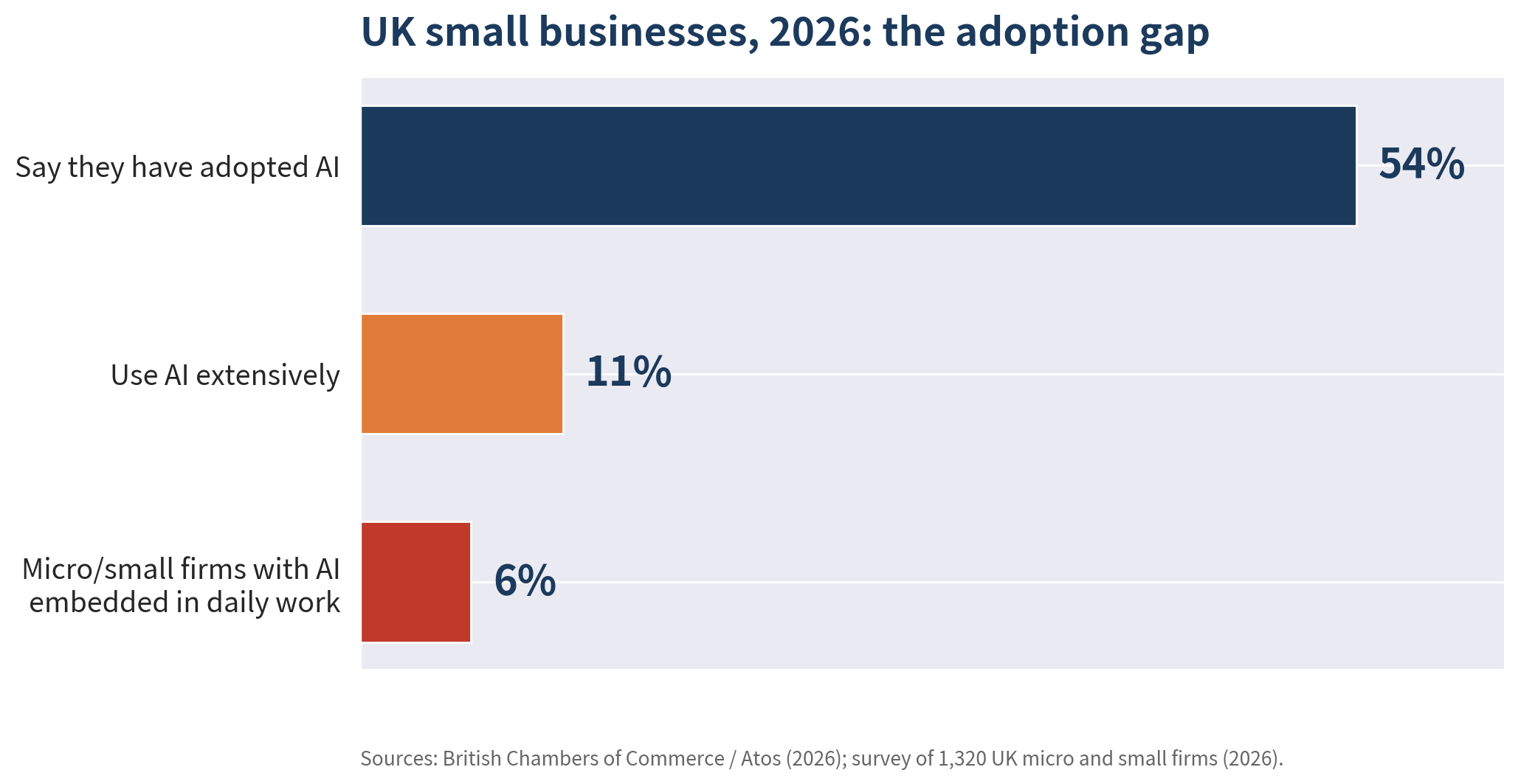
In other words: most British businesses have bought the tools and changed almost nothing. The licences are paid. The behaviour isn't.
I've spent twenty years moving people onto new technology, over a million of them, at companies like Cisco, adidas, Google and Microsoft. I've watched this exact film twice before: the internet, then social media. The pattern never changes. First the tools arrive. Then the hype. Then a long, quiet gap between having the technology and actually using it. In that gap, fortunes are made and lost.
The gap is back. It's just wearing an AI badge this time. And this time it's closing faster.
The two-tier economy nobody voted for
The Office for National Statistics puts business AI use at 29% in June 2026, up from 9% less than three years ago. Among large firms, 250 people and up, it's 44% and climbing.
Read the speed of that again. Adoption has nearly tripled in under three years, and the British Chambers of Commerce found that 38% of firms who say they intend to adopt actually do it within twelve months. The dabbling majority is not standing still. It's about to move.
So the big companies are moving, the small ones are dabbling, and the difference between "we have ChatGPT" and "AI changed how we work" is becoming the difference between the firms that pull away and the firms that wonder what happened.
If your competitor writes proposals in a day while yours take a week, you don't get the work. It really is that blunt.
It's not the technology. It was never the technology.
Ask the surveys what's blocking adoption and you get the same answer everywhere you look. Over 60% of UK businesses cite the skills gap as the main barrier, ahead of cost, ahead of security, ahead of everything. The government's own research, based on 3,500 business interviews, found the two biggest barriers were "lack of identified need" (71%) and "limited AI skills, expertise and knowledge" (60%).
Read those again. Nobody is blocked because the AI isn't good enough. They're blocked because nobody has shown them, in plain English, what to do with it on Tuesday morning.
That's the adoption gap. It's not a software problem, so buying more software won't fix it. It's a people problem, and it closes one person, one task, one real piece of work at a time.
What "properly" actually looks like
Forget transformation programmes for a moment. Properly looks like this:
The office manager who used to lose Friday afternoon to the weekly report now does it in twenty minutes, because AI knows the format, pulls the numbers, and she edits rather than assembles.
The recruiter whose candidate summaries took ten minutes each now does them in ninety seconds, and spends the saved hour on the phone, where the money is.
The owner who used to lie awake rehearsing the difficult conversation now pressure-tests it with AI the night before, and walks in prepared instead of rattled.
None of that is exotic. No agents, no code, no consultancy deck. It's one person, one recurring task, one hour of proper setup, and then it compounds. Every week the same hours come back, forever.
That's what the 11% have that the other 89% of "adopters" don't: not better tools, but a working habit built on their real work.
The reassuring bit (and it's genuinely reassuring)
Worried AI means redundancies? The ONS asked. In December 2025, just 4% of AI-using UK businesses said their headcount had fallen because of it. What actually happens is task reshaping: the same people producing more, with the drudge work compressed. In small businesses, AI absorbs the overflow; it doesn't replace the people.
So the risk was never that AI takes your team's jobs. The risk is that your competitor's team quietly becomes twice as productive while yours is still "planning to look at it".
Why the window closes
Here is the part most people miss. Gaps like this don't close politely, with everyone keeping pace. They close in a rush.
In the internet years, the businesses that moved in the first eighteen months didn't just get a website earlier. They learned earlier, ranked earlier, and compounded earlier. The late majority didn't catch up; they spent a decade paying to rent back the attention the early movers owned outright.
AI is on the same curve, steeper. The tools improve monthly. The habits compound weekly. And the 38% of "intenders" who cross over each year mean the quiet gap between the firms that use AI and the firms that say they do is becoming visible, in proposals, in response times, in margins.
Right now, crossing takes an hour and costs less than a team lunch. In two years, the same ground will cost you a transformation budget and a catch-up programme. That is the whole argument for moving this month rather than next year.
Where do you actually stand?
Not where you think. Where you actually are.
That's the question I built Everyone Uses AI to answer, and it starts with a free two-minute score: thirteen honest questions that tell you whether you're Curious, Active, or genuinely Compounding, and exactly what your next move is.
No sales call attached. No jargon. Just a straight read on where you stand and what to do next.
The gap between having AI and using it is the opportunity of this decade for normal businesses. It's open right now. It won't stay open.
Do something about it this week
Take the free AI Score and get a straight read on where you stand in two minutes.
Or skip the reading and fix one real thing: bring it to an AI Help Hour. One hour, your actual task, done together live. £160. Done, or it's refunded.
Dave Gibson is the founder of Everyone Uses AI. He built Cisco's end-user adoption business across Europe, the Middle East and Africa, helped lead digital transformation at adidas global HQ, and has worked with Google, Microsoft, BP and Accenture. Earlier in his career he published research on ubiquitous computing at the London School of Economics, cited more than 90 times.
Sources: ONS Business Insights and Conditions Survey (Jun 2026, Dec 2025) · British Chambers of Commerce / Atos Future of Work (2026) · survey of 1,320 UK micro and small firms (2026) · DSIT AI Adoption Research, GOV.UK (2026) · UK 2026 barrier surveys (over 60% skills gap, 53% cost). Bio citation count traced via ResearchGate (94 citations, LSE, ubiquitous computing).